
Why Web Design Is an SEO Decision
Every design choice on your site either helps or blocks Google from reading and ranking it. Page structure, load speed, link placement, and markup all send signals to search algorithms.
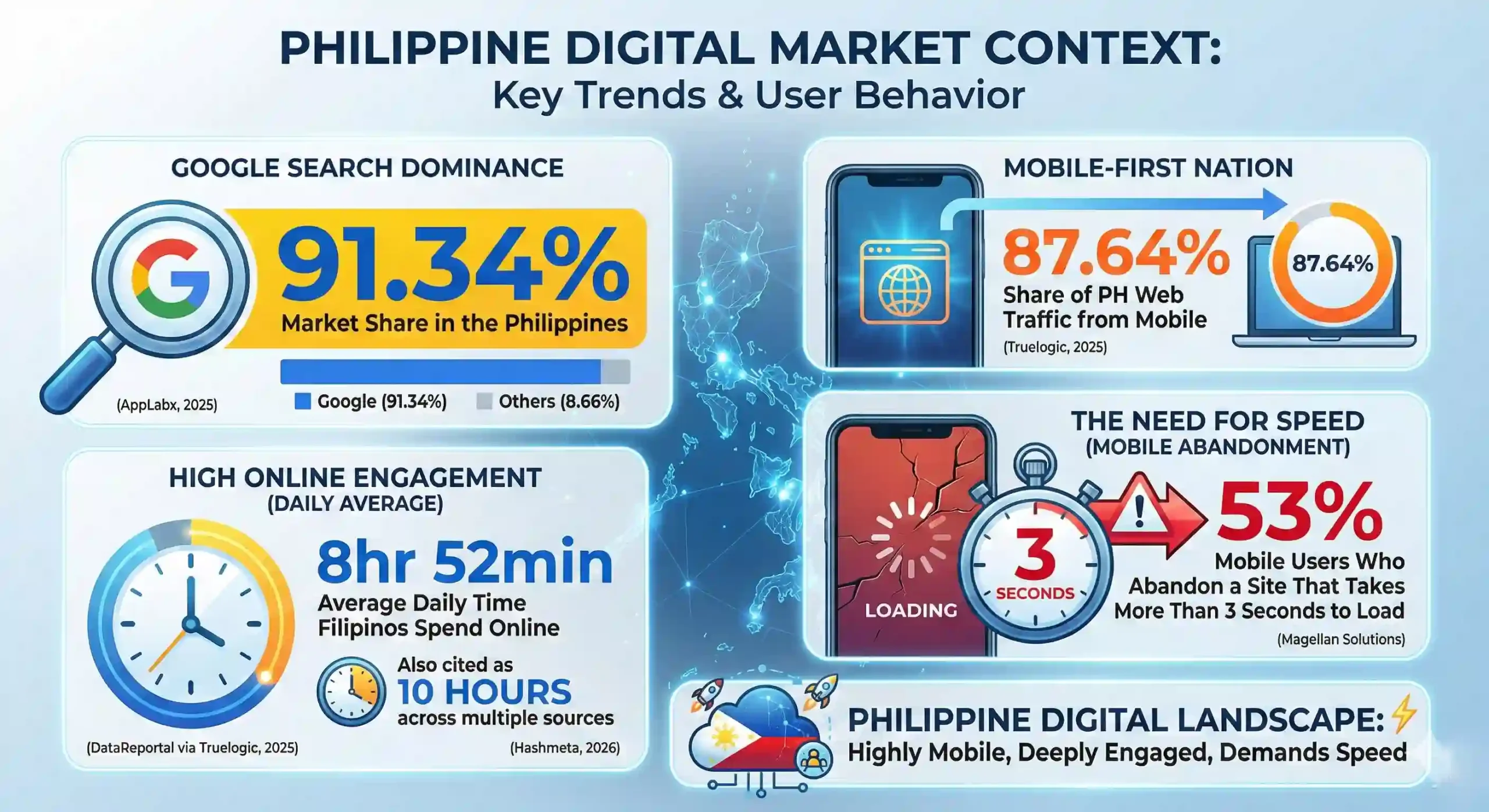
In the Philippines, those signals carry extra weight. Google holds 91.34% of the local search market (AppLabx, 2025). Filipinos spend an average of 8 hours and 52 minutes online daily (DataReportal, cited in Truelogic, 2025), and 87.64% of web traffic in the country comes from mobile devices (Truelogic, 2025).
A site that ignores mobile performance or loads slowly does not just lose users. It loses ranking eligibility in the market where it matters most.
These are the five core principles of SEO web design in the Philippines that every marketer needs to apply.
Principle 1: Build Site Architecture for Crawlability
Google crawls your site by following links. If pages are buried too deep or linked poorly, they may not get indexed at all. Good architecture makes every important page reachable.
What to get right
- Keep all key pages within 3 clicks from the homepage
- Use clean, keyword-informed URLs — avoid dynamic parameters like ?id=123
- Add breadcrumb navigation to support crawl efficiency and sitelinks
- Link between related pages using descriptive anchor text
- Deindex thin, duplicate, or outdated pages to protect crawl budget
Internal links do two things: they guide crawlers to pages and they pass authority from strong pages to weaker ones. A pillar page like this one should link down to cluster pages. Cluster pages should link back up.
Principle 2: Design for Mobile-First Indexing
Google uses the mobile version of your site to determine how it ranks, for all users, not just mobile ones. If your mobile experience is degraded, your rankings drop across the board.
With nearly 9 in 10 Filipino web visits happening on mobile, this is not optional.
Design requirements that affect ranking
- Use responsive layouts where content is identical on mobile and desktop
- Make all tap targets at least 48×48 pixels
- Avoid popups or interstitials that block content on mobile screens
- Use a minimum 16px font size for body text
- Compress images and use WebP format to reduce file size
Bandwidth considerations for the Philippine market
Internet quality varies across the archipelago. Sites that load fast in Metro Manila may time out in provincial areas. Two tools help:
- Progressive Web App (PWA) features allow pages to load even on weak connections (Hashmeta, 2026)
- A CDN like Cloudflare reduces latency by caching content closer to users across different regions
Principle 3: Meet Core Web Vitals Thresholds
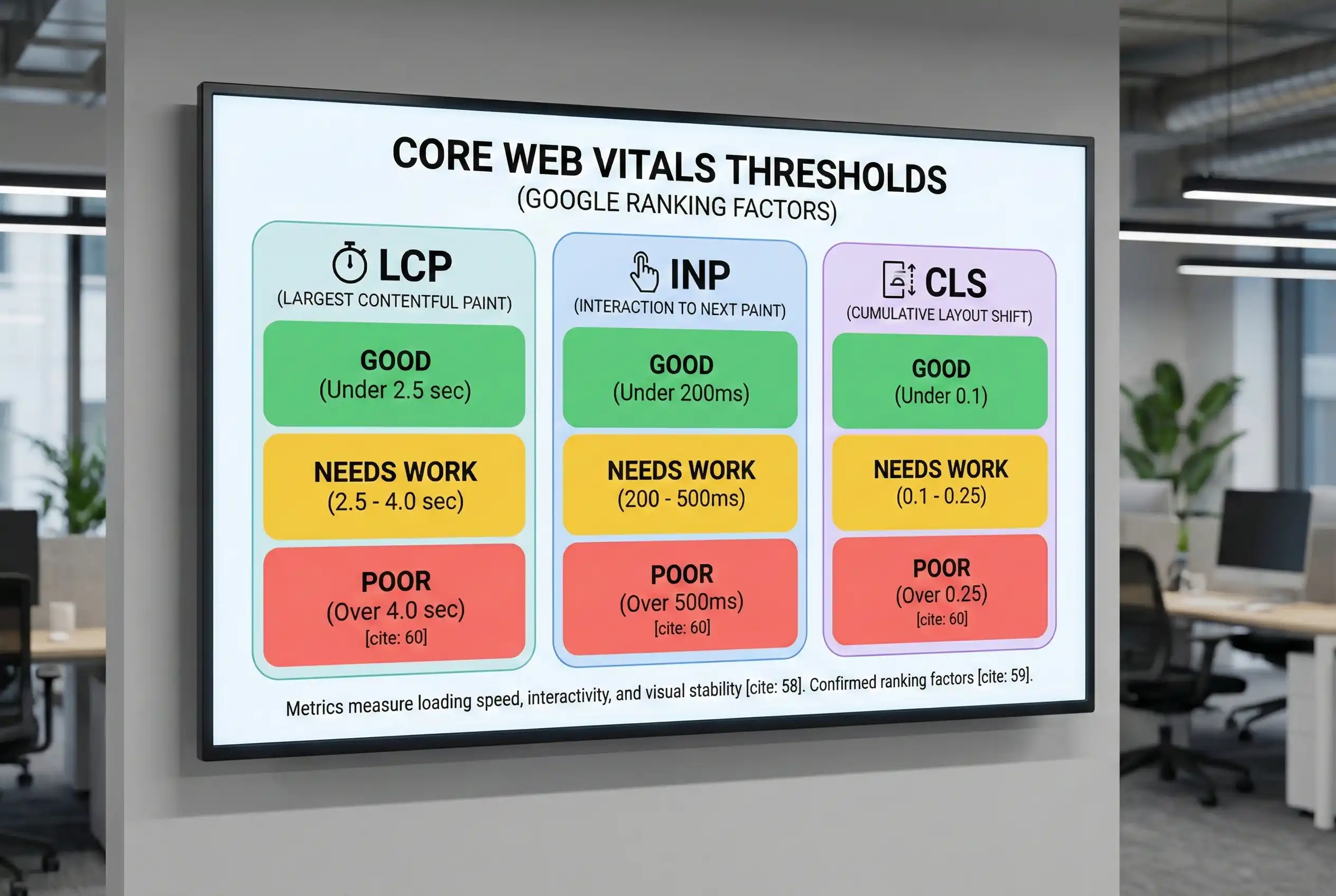
Core Web Vitals are Google’s page experience metrics. They measure how fast a page loads, how quickly it responds to input, and how stable it looks as it loads. All three are confirmed ranking factors.
Signal | Good | Needs Work | Poor |
LCP | Under 2.5 seconds | 2.5 – 4.0 seconds | Over 4.0 seconds |
INP | Under 200ms | 200 – 500ms | Over 500ms |
CLS | Under 0.1 | 0.1 – 0.25 | Over 0.25 |
Design decisions that move these scores
- LCP: Optimize hero images. Preload critical assets. Remove render-blocking scripts.
- INP: Minimize JavaScript on the main thread. Defer scripts that are not needed on load.
- CLS: Set explicit width and height on all images and embeds. Never inject content above the fold after page load.
Use Google Lighthouse to audit these scores before and after any significant design change.

Principle 4: Add Schema Markup for AI and Rich Result Visibility
Schema markup is structured data added to your HTML. It tells Google what type of content a page contains, who published it, and what entities it covers. Without it, your pages miss eligibility for featured snippets, rich results, and AI Overviews.
This matters more as AI-powered search grows. When Google’s AI Overviews appear, organic click-through rates drop from 1.41% to 0.64% for pages without structured signals (Seer Interactive, cited in DMP, 2025). Schema helps your content get included in those AI responses rather than displaced by them.
Schema types for Filipino marketer workflows
- TechArticle: For pillar pages, how-to guides, and technical content
- FAQPage: For FAQ sections, increases eligibility for People Also Ask boxes
- LocalBusiness: For businesses with physical locations in the Philippines
- BreadcrumbList: Reinforces your site hierarchy for crawlers and sitelinks
- Organization: Establishes brand entity signals that support E-E-A-T
Apply schema using JSON-LD in the page head. Validate implementation using Google’s Rich Results Test before publishing.
Principle 5: Monitor Performance with the Right Tools
Design changes affect rankings. You need a system to catch problems before they become traffic drops. Three tools cover this: Google Search Console, Google Analytics 4, and Google Lighthouse.
Tool | What It Measures | What to Act On |
Google Search Console | Indexed pages, coverage errors, Core Web Vitals field data, mobile usability, rich result status | Fix indexing gaps; resolve mobile usability flags; confirm schema is parsed correctly |
Google Analytics 4 (GA4) | Engagement rate, session duration, scroll depth, landing page performance by traffic source | Identify low-engagement pages; find entry pages with high drop-off after design changes |
Google Lighthouse | Performance score, accessibility, SEO score, Best Practices, lab-based Core Web Vitals | Run after every major deployment; target 90+ on Performance and SEO; prioritize by impact score |
Run these audits on a set schedule, not just at launch. A Lighthouse score at launch means nothing six months later after plugins, scripts, and content updates have been added.

Strategic Takeaway
What Filipino Marketers Should Do Now
- Audit your site architecture, can Google reach every key page within 3 clicks?
- Run a mobile usability test in Google Search Console to fix flagged issues first.
- Check your Core Web Vitals report in GSC, the field data shows real-user experience.
- Validate your schema markup using Google’s Rich Results Test.
- Set a monthly Lighthouse audit cadence and define performance budgets for developers.
SEO-driven web design is not a one-time setup. Every design update is a potential ranking variable. Build the habit of measuring before and after, and treat performance as a standing requirement, not a phase.
Apply these five principles of SEO web design across every Philippines market website you manage or advise on.
Frequently Asked Questions