

Why Content Structure Determines AI Visibility
AI search engines don’t read your content the way humans do. When someone asks ChatGPT or Perplexity a question, these systems scan indexed content looking for structured patterns they can extract and reassemble into coherent answers.
Traditional search engines evaluate pages as complete documents. AI search engines evaluate passages as individual units of information. If your content lacks clear structural markers, AI systems skip over it or misattribute your information to other sources.
How AI Search Engines Parse Content Differently Than Humans
AI engines process content through passage indexing. They break your page into discrete chunks and evaluate each chunk independently for relevance to specific queries. A single page might have multiple passages indexed separately, each answering different questions.
This creates an extraction problem. AI needs to understand what each passage means, how it relates to the broader topic, and whether it contains quotable information. Semantic HTML elements provide the signals AI uses to make these determinations.
When you use proper heading tags, article elements, and section containers, you’re telling AI engines how information on your page connects. H2 headings signal major topics. H3 headings signal subtopics within those sections. Section tags create clear boundaries between different ideas.
What Happens When Content Lacks Clear Structure
Content without proper structure gets ignored by AI search engines. Here’s what typically happens:
- AI engines can’t determine which passage answers which question
- Your information gets attributed to sources with better structure
- Key claims get overlooked because they’re buried in dense paragraphs
- Question-based queries skip your content entirely
- Zero-click answers pull from competitors with extraction-ready formatting
Poor structure doesn’t just hurt AI visibility. It creates extraction errors where AI misrepresents your content or combines your information with unrelated sources.
The Semantic HTML Foundation for AI Extraction
Generic div tags and span elements give AI engines no information about content meaning. Semantic HTML elements signal what type of information each section contains and how different sections relate to each other.
HTML Elements That Signal Content Hierarchy to AI
AI engines prioritize these semantic elements when parsing content:
- Article tags wrap complete pieces of content and signal self-contained information
- Section tags create clear boundaries between major topics within an article
- Aside tags mark supplementary information that supports but doesn’t belong in main content flow
- Header tags (H1-H6) establish information hierarchy and topic relationships
- Nav tags help AI understand site structure and related content connections
Here’s what proper semantic structure looks like:
Why Generic Divs and Spans Hurt AI Parseability
Divs and spans are styling containers with no semantic meaning. When AI encounters <div class=”answer”>, it sees a generic box. When AI encounters <section> with an H2 heading, it understands this marks a distinct topic boundary.
This matters because AI extraction relies on understanding information hierarchy. An H2 heading tells AI this content covers a major topic. An H3 under that H2 tells AI this content addresses a specific aspect of that topic. Generic divs provide none of these signals.
Pages built entirely with divs force AI to guess at structure based on visual patterns. Pages built with semantic HTML provide explicit structure AI can parse reliably.
Building Content Blocks AI Engines Recognize
AI engines look for recognizable content patterns when deciding what to extract. Formatting your content into specific block types dramatically increases citation probability.
Answer Block Formatting for Direct Extraction
Answer blocks pair question-based headings with immediate, concise responses. This pattern matches how AI engines expect information to be structured.
Format answer blocks like this:
Question-based H2 or H3 heading: First paragraph provides a direct answer in 2-3 sentences. No preamble, no setup, just the answer.
Second paragraph expands on the answer with supporting details or context.
AI engines extract these answer paragraphs directly because the structure signals “this is the answer to the question in the heading.”
Definition Block Structure for Entity Recognition
When you define industry terms, product names, or concepts, use a consistent definition pattern:
Term as heading: First sentence provides the definition. Second sentence adds context about why it matters or how it’s used.
This structure helps AI recognize entity definitions and increases the chance your definition gets cited when users ask “what is [term]?” AI engines specifically look for this pattern when building answers about unfamiliar concepts.
List Block Optimization for Featured Snippets and AI Citations
Lists are among the most extraction-friendly content formats. AI engines pull bulleted and numbered lists directly into answers because the structure is unambiguous.
Use bulleted lists for:
- Features or characteristics
- Benefits or advantages
- Related items without specific order
- Examples that illustrate a concept
Use numbered lists for:
- Step-by-step processes
- Ranked items
- Sequential instructions
- Procedures with specific order
Keep list items to one or two sentences. Each item should be self-explanatory without requiring the previous item for context.
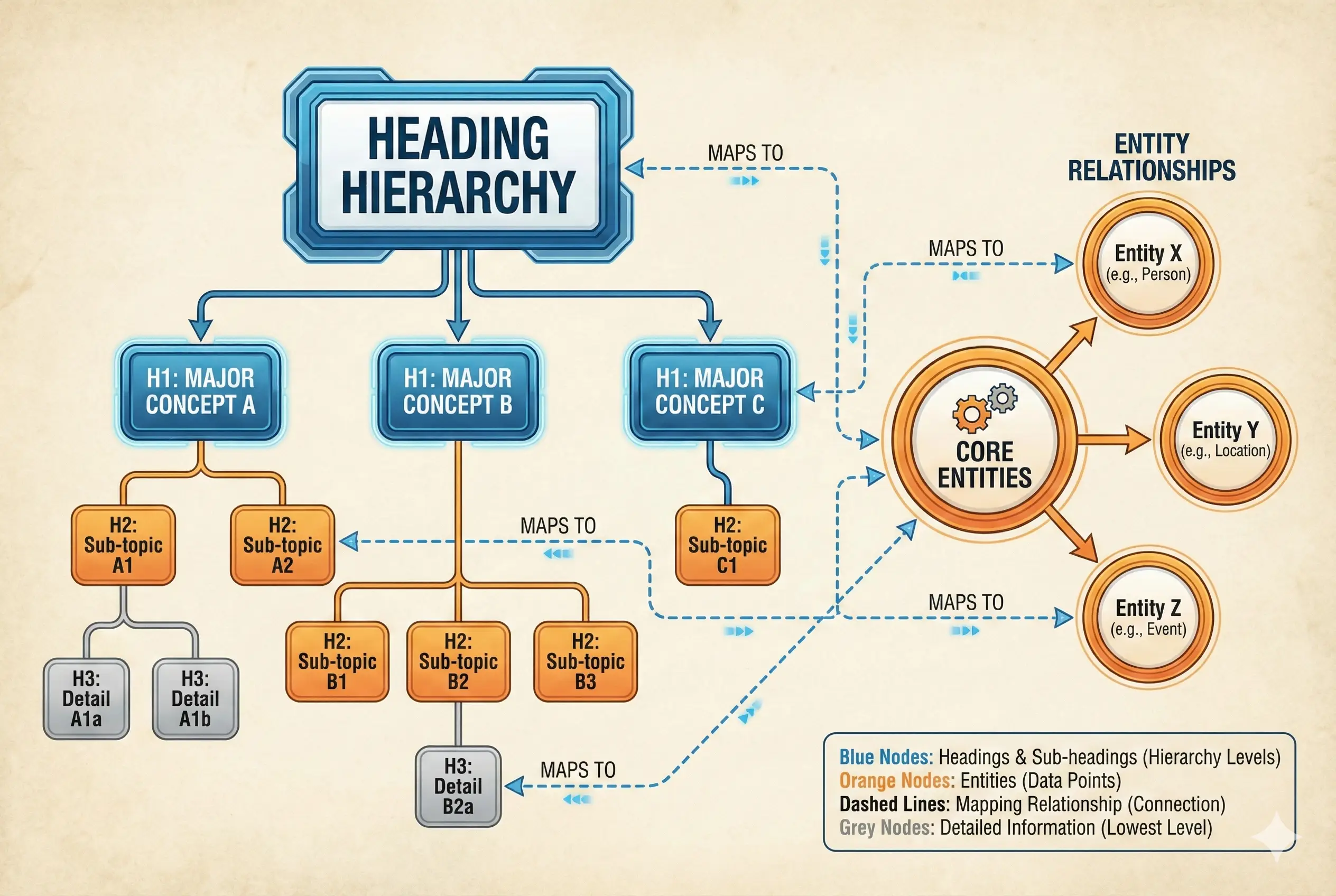
Heading Hierarchy That Maps Entity Relationships
Your heading structure teaches AI how concepts on your page relate to each other. Proper hierarchy turns isolated facts into connected knowledge.
Question-Based Headings vs Traditional Topic Headings
Traditional headings describe topics: “Email Marketing Benefits” or “SEO Best Practices.”
Question-based headings mirror actual search queries: “How Does Email Marketing Increase ROI?” or “What SEO Strategies Work in 2026?”
AI engines match user queries against indexed content. Question-based headings provide exact query matches, which dramatically increases extraction probability. When someone asks ChatGPT “How does email marketing increase ROI?” and your H2 heading uses those exact words, AI recognizes your content as highly relevant.
Transform topic headings into questions by adding interrogative words (how, what, why, when, which) and making them complete questions users would actually ask.
How Heading Levels Signal Information Architecture
H2 headings establish major topics. Every H3 under an H2 addresses a specific aspect of that major topic. Every H4 under an H3 provides detailed information about that specific aspect.
This hierarchy tells AI how information connects:
H2: Why Structure Matters for AI (major topic) H3: How AI Parses Content (specific aspect) H4: Passage-Level Indexing (detailed element) H4: Entity Recognition (detailed element) H3: What Happens Without Structure (specific aspect)
AI uses this hierarchy to understand that passage-level indexing is a component of how AI parses content, which is one reason why structure matters. The heading levels create explicit relationships AI can trace.
Never skip heading levels. Don’t jump from H2 to H4. Maintain strict hierarchical progression.
Passage-Level Optimization Techniques
AI engines extract passages as standalone units. Each passage needs to make sense without surrounding context.
Self-Contained Content Blocks That Stand Alone
Every paragraph under a heading should be independently comprehensible. Include enough context that someone reading just that passage understands what it’s about.
Weak passage: “This approach works because it provides clear signals.”
Strong passage: “Question-based headings work for AI extraction because they provide clear signals about what information follows.”
The strong version includes the subject (question-based headings) and the specific benefit (AI extraction) within the sentence. AI can extract this passage and use it accurately without needing the previous paragraph for context.
Write each paragraph as if it might be the only paragraph AI extracts from your page.
Paragraph Length and Density for AI Processing
Keep paragraphs to 2-3 sentences focused on a single concept. Dense paragraphs with multiple ideas make extraction difficult because AI can’t cleanly separate one concept from another.
Short paragraphs create clean extraction boundaries. When each paragraph covers one idea, AI can extract exactly the information needed without pulling in unrelated content.
Long paragraphs force AI to extract larger chunks or skip your content entirely. A 200-word paragraph might contain the perfect answer embedded in the middle, but AI extraction systems often bypass long blocks of text in favor of concise, focused alternatives.
Integrating Schema Markup with Content Structure
Schema markup reinforces the structure already present in your semantic HTML. The combination creates powerful signals AI engines use for extraction and attribution.
FAQ Schema for Question-Based Content Blocks
When you structure content with question-based headings and answer blocks, add FAQ schema to make the question-answer relationship explicit.
FAQ schema tells search engines “these specific questions are answered on this page” and provides the exact location of each answer. AI engines use this schema to quickly identify which passage answers which question.
Implement FAQ schema for any content section with 3 or more question-based headings. Each question becomes an FAQ item in the schema, with the answer pulled from the paragraph immediately following that heading.
Article Schema and HowTo Schema Pairing with Semantic HTML
Article schema marks your content as a complete article and provides metadata about publication date, author, and topic. HowTo schema adds step-by-step structure for instructional content.
Use both schemas together when you have instructional content within an article format. The Article schema establishes credibility and freshness. The HowTo schema highlights the procedural elements AI engines look for when answering “how to” queries.
The key is alignment. Your schema should reflect the actual structure of your HTML. If your HowTo schema lists 5 steps, your content should have 5 clearly marked sections or numbered list items covering those steps.
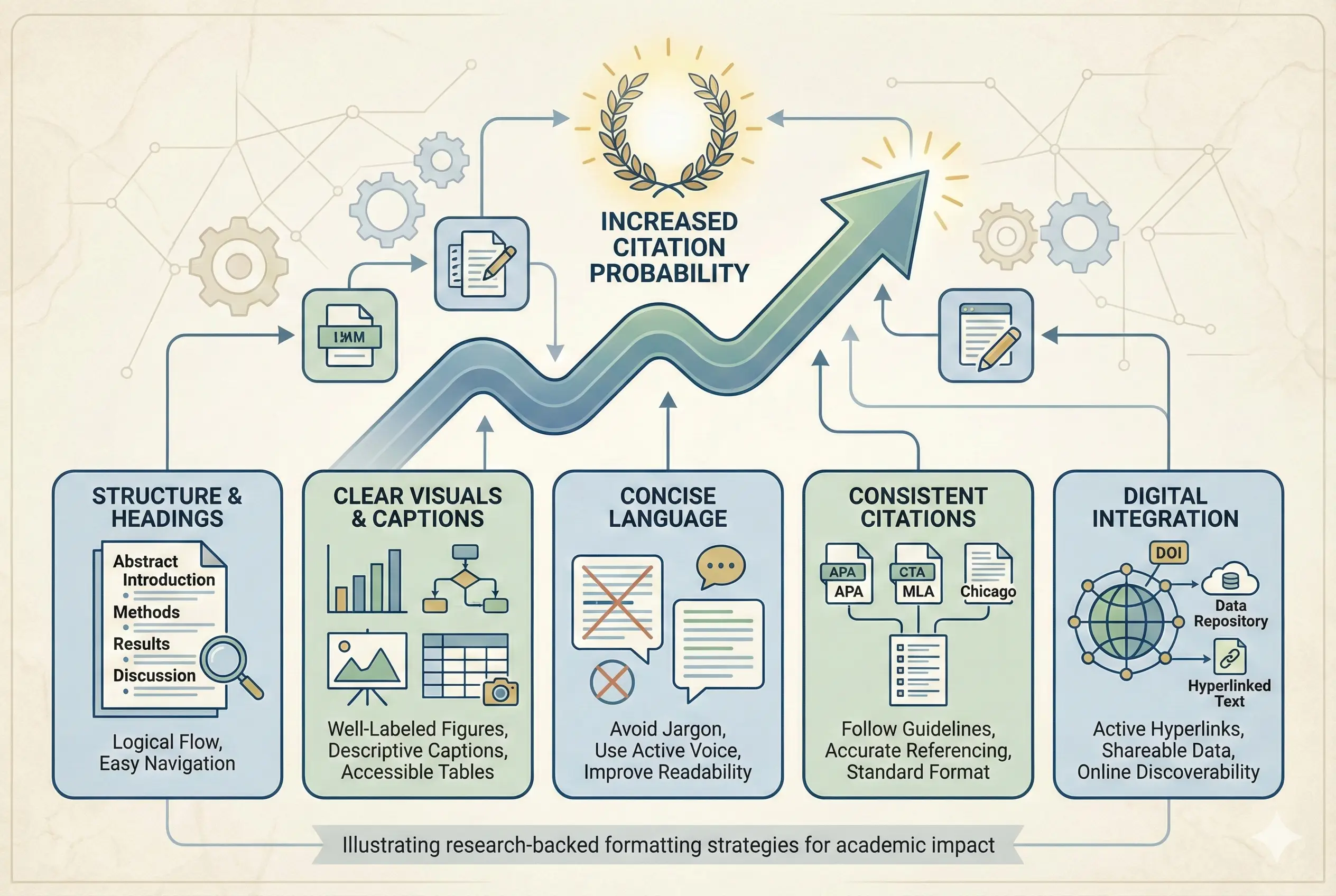
Formatting Patterns That Increase Citation Probability
Certain formatting patterns consistently perform well for AI extraction. These patterns match how AI systems expect information to be organized.
The Answer-First Content Pattern
Structure every section as: direct answer, supporting details, examples.
Put the core answer in the first paragraph under each heading. Use the second and third paragraphs to add nuance, context, or qualifications. Include examples last.
This pattern works because AI extraction prioritizes content near headings. When users ask questions, AI pulls the first paragraph under relevant headings. If that paragraph contains qualifications, caveats, or background instead of the actual answer, AI often skips to a competitor’s content with clearer answer-first structure.
Attribute Clearly Pattern for Data and Statistics
When you include statistics, research findings, or expert quotes, format them with explicit attribution in the same sentence.
Weak attribution: “Studies show this approach improves results. According to research from Stanford, the improvement averages 40%.”
Strong attribution: “Research from Stanford found this approach improves results by an average of 40%.”
The strong version keeps the data and its source together in a single extractable sentence. AI can cite this cleanly without needing to combine information from multiple sentences.
Always include the source name in the same sentence as the claim. This prevents misattribution and makes your content more quotable for AI systems that prioritize properly sourced information.
Strategic Takeaway
AI search engines extract information from content with clear structural patterns. Semantic HTML elements establish hierarchy. Question-based headings mirror actual queries. Self-contained passages enable clean extraction. Schema markup reinforces visible structure.
Start by auditing your current content structure. Identify pages without proper semantic HTML and rebuild them with article, section, and header tags. Transform topic headings into question-based headings. Break long paragraphs into focused 2-3 sentence blocks.
Test your changes by searching for questions your content answers in AI search engines. Track whether your content appears in citations. Monitor which structural patterns increase your visibility.