

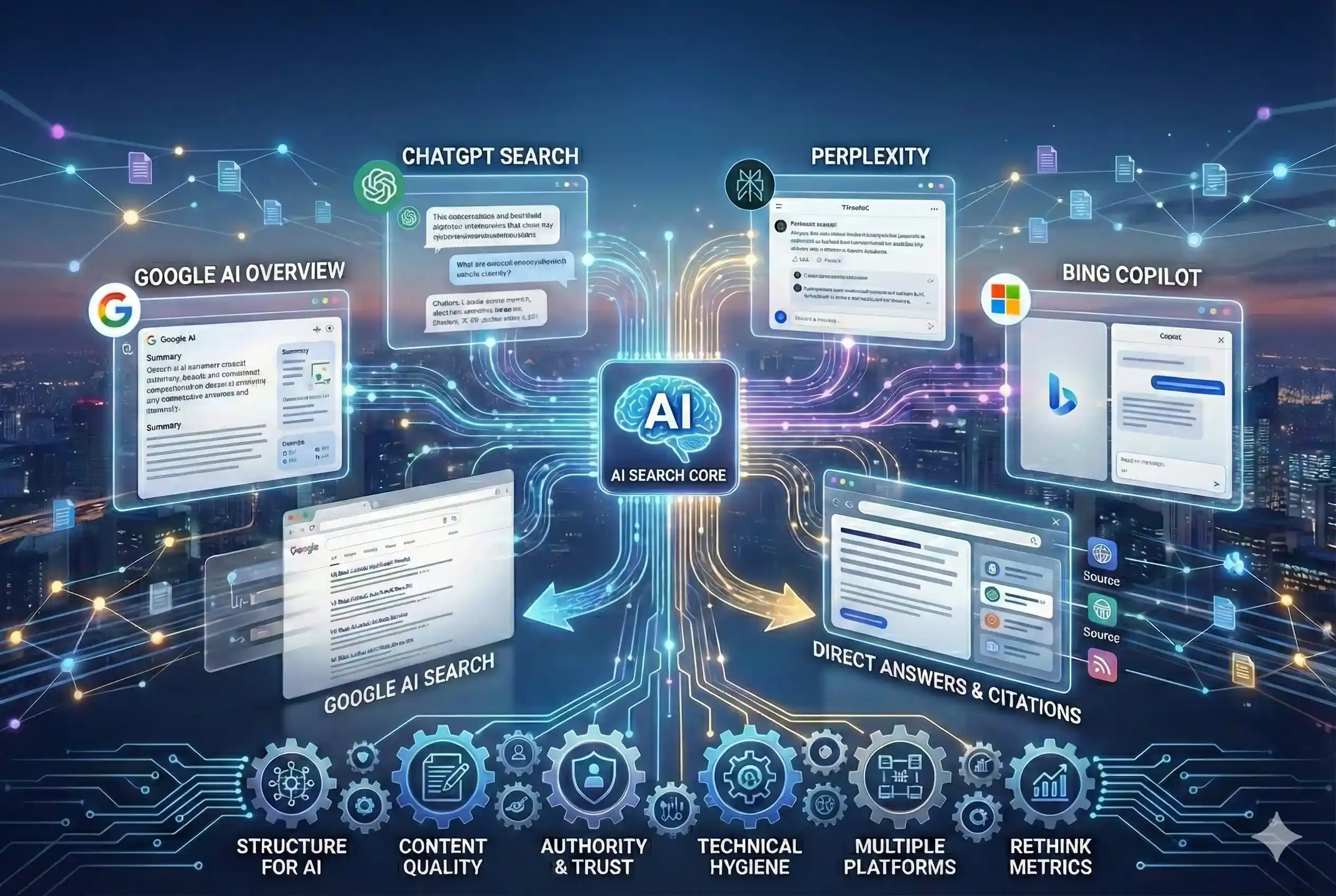
Search is changing in front of us.
Google still dominates with 90% market share. But millions of people now start their searches in ChatGPT. Others use Perplexity to find answers with clear sources. Microsoft’s Bing Copilot responds to questions with AI-generated summaries.
The shift isn’t about one platform replacing another. Traditional search engines and AI-powered answer engines will coexist. Users will choose different tools for different needs.
This creates a new challenge for marketers. You can’t just focus on ranking in Google anymore. You need visibility across multiple platforms. You need your content to be cited in AI-generated answers. You need to understand how these systems work and what they value.
This guide explains what AI Search means, how major platforms work, and what changes for your SEO strategy. No hype. No predictions about Google dying. Just practical information about where search is heading and how to adapt.
What is AI Search?
AI Search combines traditional search functionality with generative AI. Instead of showing a list of blue links, these systems generate conversational answers based on information they find across the web.
The experience feels different from traditional search. You ask a question in natural language. The system responds with a synthesized answer, often including sources and citations. You can ask follow-up questions. The conversation continues.
Key characteristics of AI Search:
- Uses large language models to understand queries and generate responses
- Provides direct answers instead of just links to websites
- Shows sources and citations for the information provided
- Allows conversational follow-up questions
- Processes text, images, and video to create answers
AI Search doesn’t replace traditional search engines. Google, for example, still shows traditional results alongside AI Overviews. But it changes how people interact with search and what they expect from results.
Traditional Search vs. AI Search
The differences matter for how you think about optimization.
- Query Format. Traditional search uses short keyword phrases. “best running shoes” or “pizza near me.” AI Search handles conversational questions. “What running shoes should I buy if I have flat feet and run on pavement?”
- Results Format. Traditional search returns a ranked list of web pages. AI Search generates a synthesized answer with sources linked throughout the response.
- User Behavior. With traditional search, users scan results, click links, and browse multiple pages. With AI Search, users read the generated answer, check sources if needed, and ask follow-up questions in the same session.
- Marketer Goal. Traditional SEO focuses on ranking for specific keywords. AI Search optimization focuses on getting cited as a source within generated answers.
Both approaches still matter. Your website needs to rank in traditional results AND be chosen as a credible source for AI-generated content.

Major AI Search Platforms in 2026
Four main platforms shape the AI Search landscape:
- Google AI Overviews appear at the top of search results for many queries. Google’s generative AI creates these summaries using information from multiple web sources. Thke system shows citations throughout the answer. Users still see traditional search results below the AI Overview.
- ChatGPT Search integrates web search directly into ChatGPT conversations. When users ask questions that need current information, ChatGPT searches the web and generates answers with source citations. The experience stays conversational throughout.
- Perplexity built its entire platform around AI-powered search. Every answer includes numbered citations linking to sources. Users see the answer first, then can explore the original sources. The platform emphasizes transparency about where information comes from.
- Bing Copilot combines Microsoft’s search index with AI generation. The system works across Microsoft products, from the Bing search engine to Edge browser to Windows. Responses include citations and traditional search results.
Each platform works differently. Each prioritizes different types of content. A strong AI Search strategy considers all of them, not just one.
How AI is Changing Search Behavior
User behavior is shifting along with the technology.
People ask longer, more specific questions. Instead of “italian restaurants boston,” they ask “what are the best italian restaurants in boston’s north end for a romantic dinner under $100 per person?”
Search becomes conversational. Users ask follow-up questions based on the previous answer. “What about vegetarian options?” or “Which one has the best outdoor seating?”
The pattern changes from search-click-browse to search-read-refine. Users spend more time engaging with answers and less time clicking through multiple websites.
From Single Queries to Conversations
Traditional search treats each query independently. You search, get results, and start over with a new search if you need different information.
AI Search maintains context across multiple queries. The system remembers what you asked before. Your second question builds on your first. Your third question refines the earlier answers.
This changes how people use search. They explore topics through conversation rather than through repeated keyword searches. They ask “why?” and “how?” as follow-up questions. They compare options without opening multiple tabs.
For content creators, this means thinking beyond individual keywords. Your content needs to answer the follow-up questions people will ask. It needs to provide depth, not just surface-level information.
The Multi-Platform Search Journey
Users don’t stick to one platform anymore.
Someone might start with Google to get a quick answer. Then move to ChatGPT to explore the topic in depth. Then check Perplexity to verify sources. Then return to Google to find specific products or services.
Different platforms serve different needs:
- Google for quick facts and local information
- ChatGPT for detailed explanations and brainstorming
- Perplexity for research with clear sources
- Bing Copilot for tasks integrated with Microsoft products
A complete search strategy accounts for all these platforms. Your content needs to be discoverable across different systems. Your brand needs to be cited consistently across different AI-generated answers.
This is harder than traditional SEO. But it’s also an opportunity. Many brands haven’t adapted yet. Early movers gain an advantage.
What Changes for SEO Strategy
The good news: traditional SEO fundamentals still matter. The challenge: new priorities layer on top of existing work.
AI Search systems need the same foundation as traditional search engines. They crawl websites. They evaluate content quality. They consider site authority and user experience.
Strong technical SEO makes your site accessible to AI crawlers. Quality content gives AI systems something worth citing. Clear site structure helps AI understand your expertise and topic coverage.
The difference comes in how AI systems evaluate and present information. Traditional search ranks pages. AI Search chooses sources to cite and quote within generated answers.
Traditional SEO Fundamentals That Still Matter
Don’t abandon core SEO practices. They enable AI visibility.
- Site speed and performance matter even more. AI crawlers and agents need fast responses. Slow sites get skipped.
- Mobile optimization is table stakes. Most AI Search happens on mobile devices. Poor mobile experience means poor AI experience.
- Clear site structure helps AI systems understand your content hierarchy. Good navigation, logical URL structure, and internal linking show how your content connects.
- Quality content that serves user intent remains the foundation. AI systems can’t cite content that doesn’t exist or doesn’t answer questions well.
- Strong E-E-A-T signals become more important. Experience, expertise, authority, and trustworthiness help AI systems decide which sources to trust and cite.
Keep doing what works for traditional SEO. These practices create the foundation AI optimization builds on.
New Optimization Priorities for AI Search
Layer these priorities on top of existing SEO work:
- Citations and Sources Getting your content cited in AI-generated answers becomes a key metric. This requires creating authoritative, quotable content. It means building your brand’s reputation beyond your own website.
- Structured Data Schema markup helps AI systems understand your content. Product information, author credentials, reviews, FAQ content, and article structure all become more machine-readable with proper schema implementation.
- Content Quality AI can generate generic information. It looks for unique insights, original data, and perspectives it can’t create on its own. Content needs to provide value beyond what AI can generate.
- Authority Signals AI systems evaluate trust differently than search engines. Brand mentions across the web, quality backlinks from recognized sources, expert author profiles, and user-generated content all signal authority.
- Multi-format Content AI processes more than text. Video transcripts, image descriptions, infographics, and podcast content all factor into how AI understands and cites your expertise.
How to Get Cited by AI Search Engines
Getting cited requires intentional content strategy.
AI systems look for clear, well-structured information they can extract and quote. They prefer authoritative sources with strong trust signals. They value content that answers questions directly and provides unique information.
Your goal shifts from ranking to being the best answer. The clearest explanation. The most comprehensive data. The most trusted source.
Content Structure for AI Extraction
Make your content easy for AI to understand and quote.
- Use clear headings that match common questions. H2 and H3 tags should directly answer what users ask. “What is X?” “How does Y work?” “When should you Z?”
- Provide concise definitions early in your content. AI systems often quote the first clear explanation of a concept. Lead with your best answer.
- Use bullet points for key information. Lists are easy to extract and quote. They work well in generated answers.
- Include tables for comparisons and structured data. AI systems use tables to present information clearly. Well-formatted tables get cited frequently.
- Add summary sections that distill key points. These sections become quotable snippets in AI answers.
Write for extraction. Assume AI will quote individual paragraphs without surrounding context. Make each section self-contained and clear.
Building Authority and Trust Signals
AI systems evaluate credibility beyond your own website.
- Quality backlinks from reputable sources signal authority. Focus on earning links from recognized publications, industry websites, and educational institutions.
- Brand mentions across the web build recognition. Being discussed in articles, podcasts, and social media helps AI systems understand your relevance and expertise.
- Expert author bios establish credibility. Clear author profiles with credentials and background help AI systems trust your content.
- Customer reviews and testimonials provide social proof. User-generated content signals that real people value your product or service.
- Engagement metrics matter too. Content that people share, comment on, and reference gets prioritized by AI systems.
Build authority beyond your own domain. The mentions and recognition you earn elsewhere directly impact AI citations.

Strategic Takeaway: Adapting to the AI Search Era
The transition to AI Search isn’t a revolution. It’s an evolution.
Traditional search won’t disappear. Google maintains 90% market share. But AI-powered platforms are growing fast. User behavior is changing. Expectations are shifting.
Smart marketers adapt without overreacting.
- Continue traditional SEO fundamentals. Technical optimization, quality content, and strong site structure enable AI visibility. These practices don’t become obsolete. They become more important.
- Create content AI can extract and cite. Clear structure, concise answers, and unique insights make your content quotable. Focus on being the best answer, not just ranking first.
- Build authority beyond your website. Brand mentions, quality backlinks, and expert recognition signal trust to AI systems. Invest in reputation building across the web.
- Think multi-platform, not just Google. Optimize for visibility across different AI Search tools. Each platform has different strengths and audiences.
- Focus on being recommended. AI Search changes the goal from ranking to being cited. Create content AI systems want to reference. Build the authority they want to trust.
The future of search combines traditional rankings with AI-generated answers. Success requires excellence in both. Start adapting now while competition is still catching up.
If you’re an SEO specialist, freelancer, or agency owner navigating this shift, SearchGen is a free, community-driven network where digital marketers collaborate, upskill, and grow in the age of AI search.