


Introduction
Google search results look different now.
Type a question into Google and you might see an AI-generated summary at the top of the page before any traditional links appear. This summary answers your question directly, pulling information from multiple websites and citing its sources throughout the response.
This feature is called AI Overviews. It’s Google’s answer to the rise of ChatGPT, Perplexity, and other AI tools that people increasingly use instead of traditional search engines.
AI Overviews don’t appear on every search. They show up for certain types of queries where an AI-generated answer adds value. When they do appear, they fundamentally change how users interact with search results and how websites get visibility.
This article explains what AI Overviews are, how they work, and why Google introduced them. No speculation about the future. Just the practical reality of what’s happening in search results today.
What Are AI Overviews?
Definition and Visual Description
AI Overviews are summaries generated by Google’s artificial intelligence that appear at the top of search results pages. They sit above everything else, including ads, Featured Snippets, and organic results.
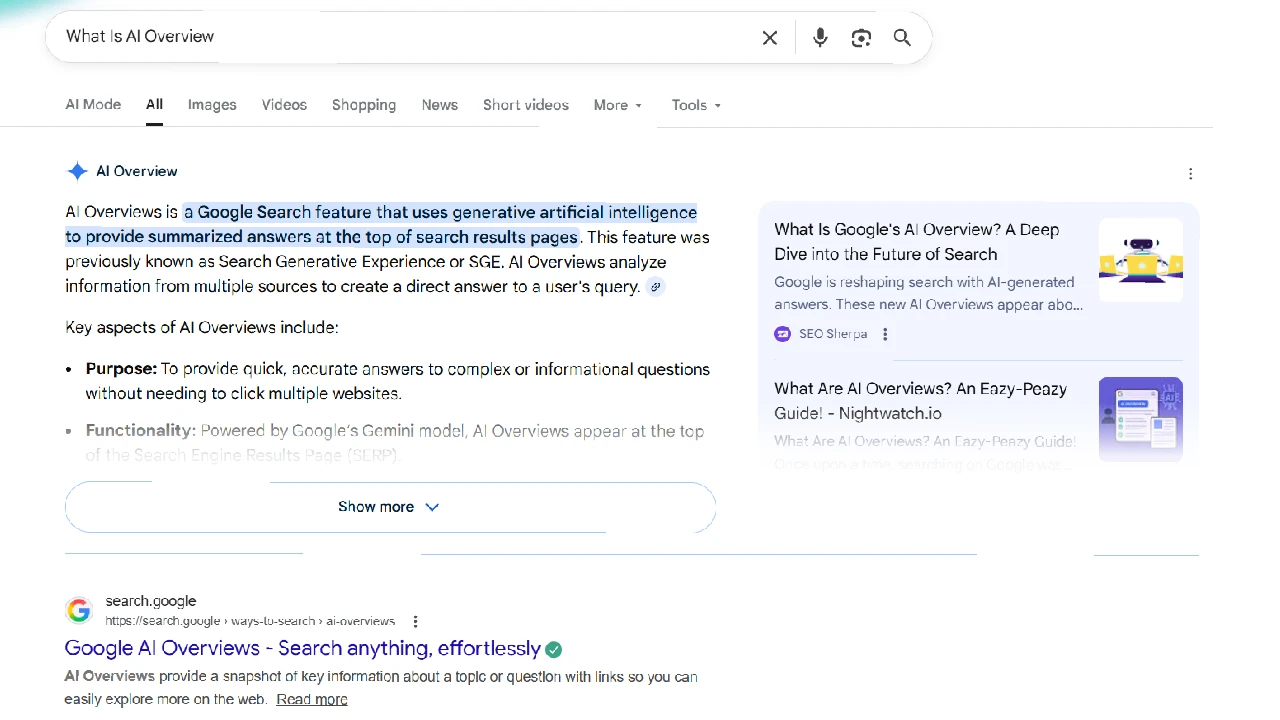
The AI creates these summaries by reading information from multiple websites across the web. It synthesizes what it finds into a cohesive answer written in conversational language. Citations appear throughout the response as link cards showing which sources Google used.
Users see a direct answer to their question without clicking any links. If they want more information, they can expand the AI Overview to see additional details or click through to the cited sources.
When and Where AI Overviews Appear
AI Overviews don’t show up for every Google search. They appear selectively based on query type and search intent.
You’ll most commonly see them for informational queries that need explanation or context. Questions starting with “what,” “how,” or “why” frequently trigger AI Overviews. Comparison queries and requests for step-by-step guidance also commonly get AI-generated answers.
They appear less often for navigational searches where users want a specific website, transactional queries where users want to buy something, or local searches looking for nearby businesses.
Research from Semrush analyzing search data in 2025 found that AI Overviews appeared for different query types at varying rates, with informational queries showing the highest frequency.
What AI Overviews Look Like
AI Overviews appear as a text block at the top of the search results page. The answer uses natural, conversational language rather than bullet points or fragments.
Citations appear as small link cards within and below the answer. Each card shows the website’s favicon, page title, and domain. Users can click these cards to visit the source.
Many AI Overviews include a “Show more” option that expands the answer with additional information. Some include follow-up questions users might ask related to the original query.
Traditional search results appear below the AI Overview, maintaining the familiar list of blue links users expect from Google.
How AI Overviews Work
The Technology Behind Them
Google’s large language models power AI Overviews. These models understand natural language queries and generate human-like text responses.
When you search, the AI doesn’t just find pages that match your keywords. It interprets what you’re actually asking, searches Google’s index for relevant information, and creates a new response that answers your specific question.
The system combines real-time web search with generative AI. It accesses current information from Google’s search index rather than relying solely on training data. This allows AI Overviews to include recent information and cite current sources.
How Google Selects Sources
Google’s AI evaluates web pages the same way traditional search does. It crawls and indexes content, assesses relevance to the query, and considers authority signals like backlinks and domain reputation.
The difference comes in how AI Overviews use these sources. Instead of ranking pages in a list, the AI extracts information from multiple relevant pages and combines it into a single answer.
Source selection prioritizes authoritative, trustworthy websites. Content needs to be well-structured and clearly written for the AI to extract and cite it effectively.
The Generation Process
The AI Overview generation happens in stages:
- Google’s AI interprets your search query and identifies your intent
- The system searches Google’s index for relevant pages
- The language model reads information from multiple sources
- The AI generates a synthesized answer combining these sources
- Citations are added linking to the original pages
- The answer appears at the top with traditional results below
This process happens in seconds, creating a unique response for each query rather than showing pre-generated content.
AI Overviews vs Featured Snippets
Key Differences
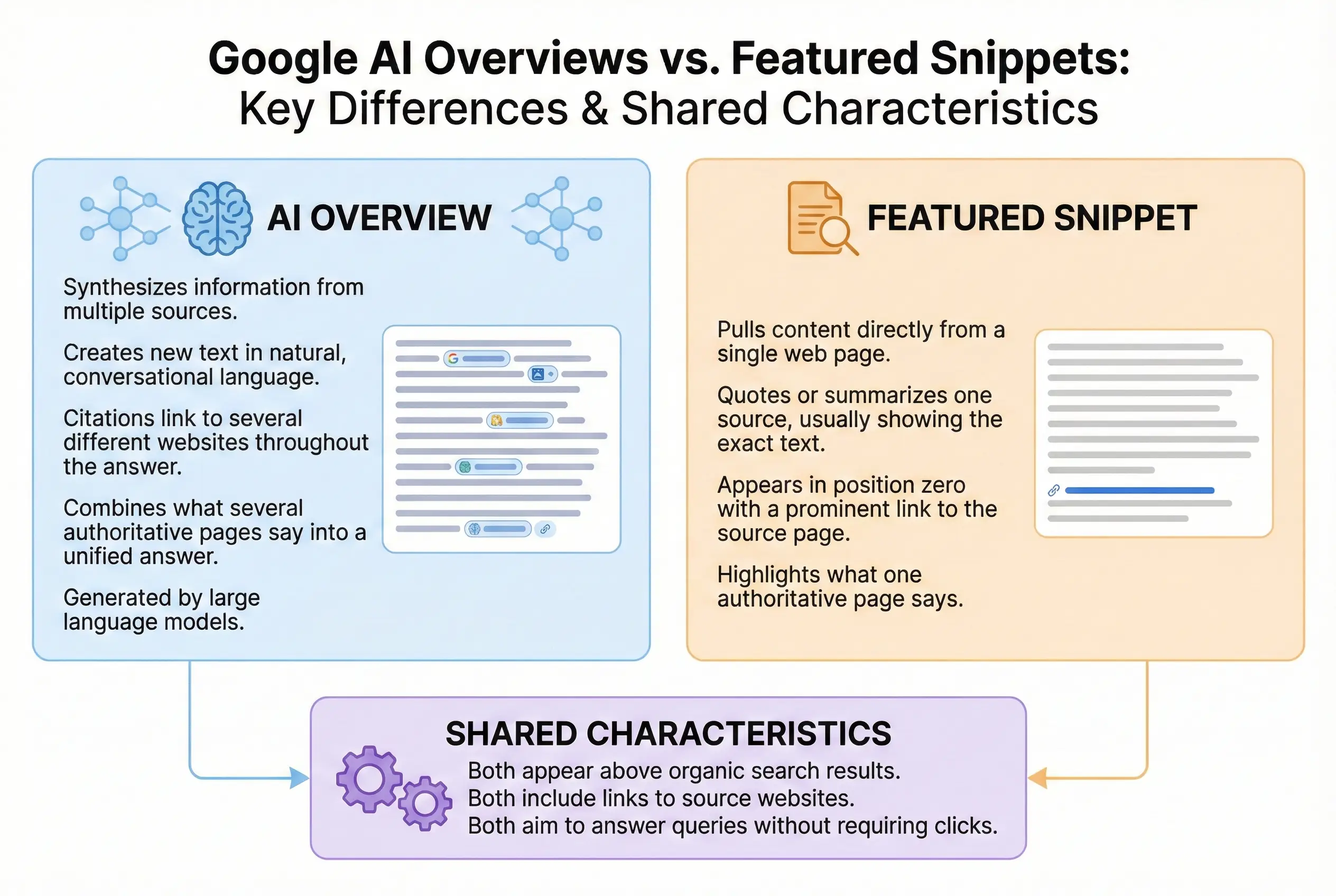
Featured Snippets and AI Overviews both appear above organic search results, but they work differently.
Featured Snippets pull content directly from a single web page. They quote or summarize one source, usually showing the exact text from that page. The snippet appears in position zero with a link to the source page.
AI Overviews synthesize information from multiple sources. They create new text rather than quoting existing content. Citations link to several different websites throughout the answer rather than highlighting just one source.
Featured Snippets show what one authoritative page says. AI Overviews combine what several authoritative pages say into a unified answer.
What Stayed the Same
Both features aim to answer queries without requiring clicks. Both appear prominently at the top of search results. Both include links to source websites.
For users, both features provide faster answers. For websites, both create opportunities for visibility and both potentially reduce click-through rates by answering questions directly in the SERP.
The fundamental goal remains the same: help users find answers quickly while still directing them to quality web sources when they need more information.
Why Google Introduced AI Overviews
Competition from AI Chat Tools
ChatGPT launched in late 2022 and quickly attracted millions of users. Perplexity built its platform entirely around AI-generated answers with sources. These tools gave users a new way to find information that felt faster and more conversational than traditional search.
Google needed to respond. Users were starting to bypass Google and ask ChatGPT their questions instead. AI Overviews represent Google’s answer to this competitive threat.
The feature keeps users in Google’s ecosystem while providing the conversational AI experience they increasingly expect.
User Behavior Changes
Search behavior has evolved beyond simple keyword queries. People ask complex, multi-part questions. They want explanations and context, not just links to click.
Mobile search increased the demand for immediate answers. Scrolling through ten blue links and opening multiple pages works poorly on a phone. AI Overviews provide the answer right at the top.
Users also showed preference for synthesized answers over fragmented information across multiple sites. Combining information from several sources into one coherent response matches how people actually want to consume information.
Evolution from SGE
Google first introduced this technology as Search Generative Experience (SGE) in May 2023. SGE was an experimental feature available to limited users who opted in to test it.
In May 2024, Google rebranded SGE to AI Overviews and began rolling it out to all US users. The rebrand reflected the feature moving from experiment to standard search functionality.
By late 2024, AI Overviews appeared in search results for hundreds of millions of queries. Google expanded availability to additional countries throughout 2024 and into 2025.
The evolution from experiment to standard feature shows Google’s commitment to AI-generated answers as part of search’s future.
Impact on Search Experience
For Users
AI Overviews answer complex questions faster than traditional search. Instead of opening five tabs and comparing information across sites, users get a synthesized answer immediately.
The citation system provides transparency. Users see which sources Google used and can click through if they want to verify information or read more detail.
For straightforward questions with clear answers, AI Overviews eliminate unnecessary clicking. For complex topics requiring deep research, they provide a useful starting point before diving into specific sources.
For Websites
AI Overviews create zero-click searches where users get their answer without visiting any website. This can reduce organic traffic for sites that previously ranked well for informational queries.
However, citations within AI Overviews provide a new visibility opportunity. Being cited as a source can drive traffic from users who want to learn more or verify the information.
The shift changes optimization priorities. Ranking alone no longer guarantees traffic. Content needs to be structured for AI extraction and authoritative enough that Google’s AI chooses it as a credible source to cite.
Citation Behavior
AI Overviews typically cite three to eight sources per answer. Citations appear as inline links within the generated text and as link cards below the answer.
Each citation shows the website’s favicon, page title, and domain. This gives users context about the source before clicking.
Research on click-through behavior for AI Overview citations shows varied results. Some cited sources see traffic increases. Others see minimal clicks despite being featured prominently in the AI-generated answer.
Strategic Takeaway
AI Overviews represent Google’s response to competition from ChatGPT and other AI tools that changed how people expect to find information online. They’re not replacing traditional search results but adding a new layer on top.
Understanding how AI Overviews work helps you adapt your content strategy. The focus shifts from just ranking in traditional results to also being cited within AI-generated answers. Both matter for visibility.
The technology continues to evolve. Google adjusts which queries trigger AI Overviews, how citations appear, and how the AI selects sources. Staying current with these changes matters for maintaining search visibility.
Digital marketers navigating these changes can find peer support and forward-looking resources at SearchGen, a free community built for SEO professionals and freelancers.